Every boot room has a pair. Muddy, a bit cracked round the ankle, and still the first thing you reach for on a wet morning. The welly is so ordinary that we rarely think about where it came from, but its story takes in a famous Duke, two American inventors, a million pairs of boots for the trenches and a small team of French bootmakers who still make them by hand.
It started with leather, not rubber. In the early 1800s, the fashionable boot for a gentleman was the Hessian: tall, with a decorative trim and a tassel at the front. Arthur Wellesley, the 1st Duke of Wellington, asked his shoemaker, Hoby of St James’s Street in London, to make him something more practical.
Hoby took the trim off, made the boot in soft calfskin and cut it to fit closely around the leg. It was smart enough for the evening and hard-wearing enough for riding. After the Duke’s victory at Waterloo in 1815, anything connected with him was in fashion, and gentlemen across the country wanted a pair of “Wellingtons”. The name has stuck ever since, and it is why, two hundred years on, we still call them “wellies”.
The Duke’s boots were leather, and leather lets the water in sooner or later. The change came from America. In the 1840s, Charles Goodyear found a way of treating natural rubber, known as vulcanisation, that stopped it going sticky in the heat and brittle in the cold.
In 1852, an American businessman called Hiram Hutchinson met Goodyear and bought the rights to use the process for footwear. He moved to France and, in 1853, set up a company at Montargis to make waterproof rubber shoes and boots. The business became known as À l’Aigle, “At the Eagle”, said to be in honour of his home country. Today we know it simply as Aigle.
Only three years later, another American, Henry Lee Norris, arrived in Scotland with Goodyear’s patent. In 1856 he set up the North British Rubber Company at Castle Mill in Edinburgh, making rubber goods of all kinds, including boots. The company would later become Hunter.
So within the space of three years, two Americans had brought the rubber welly to France and to Britain.
The wellington’s big moment came in the First World War. The trenches of the Western Front were often flooded, and soldiers stood for days in cold water and mud. The War Office asked the North British Rubber Company for a sturdy trench boot, and the Edinburgh factory made 1,185,036 pairs to keep up with the Army’s demands.
The factory was busy again in the Second World War, when around 80 per cent of what it made went to the war effort. When the soldiers came home, many had got used to wellies, and they soon became everyday wear on farms, in gardens and for anyone who worked outside.
The green welly as we know it arrived in 1955, when the Edinburgh company, now known as Hunter, launched its Original Green Wellington. It was a slow start: an order of 36 pairs was seen as an achievement. That changed in 1980, when photographs of Lady Diana Spencer wearing a pair on the Balmoral estate appeared in the papers. Sales took off, and the “Green Welly Brigade” was born.
While British wellies were being made in their millions, a different kind of boot was taking shape in France. In 1927, Claude Chamot began making rubber boots by hand in Cherbourg, in Normandy. In 1949 he opened a workshop in Casablanca and renamed the business Le Chameau, “the camel”, as a mark of respect for the skill of his craftsmen in Morocco.
In 1950, Le Chameau made the first rubber boot lined with leather. In 1965 it introduced the Vierzon, the first wellington with an adjustable waterproof gusset, named after a French town known for hunting and fishing. It is still one of the best-loved country boots today, and each pair is still made by hand. It takes nine months to train as one of Le Chameau’s master bootmakers.
Aigle, meanwhile, moved its boot making to Ingrandes, near Châtellerault, in 1967, where its master bootmakers still work today.
The welly has come a long way from the Duke’s calfskin boots. Today you can choose a leather or neoprene lining for warmth, a side gusset for a better fit around the calf, or a lighter boot for summer dog walks. Alongside the French makers, Barbour now makes its own wellingtons, and Ariat, founded in California in 1993 by two friends who brought athletic shoe technology to riding boots, makes boots for the yard and the field.
If you are not sure which pair would suit you, have a look at our guide to the best country and yard boots.
A good pair of wellies can last for many years with a little care. Rinse off mud with clean water after use, let them dry naturally away from radiators and direct sunlight, and store them upright somewhere cool. Heat and sunlight are what dry the rubber out and cause cracking.
And if a small hole or split does appear, it does not have to be the end. A dab of Stormsure flexible repair adhesive will seal it and get you plenty more wear. It sets flexible, so the repair bends with the boot rather than cracking off, and it works on wellies, waders and waterproofs alike. Spread it a little beyond the hole and leave it to set undisturbed before you wear them again. You will find it in the shop and online in our footwear section.
Even a well-loved pair reaches the end of the road eventually, usually when a split starts letting the puddles in. But an old welly does not have to go in the bin.
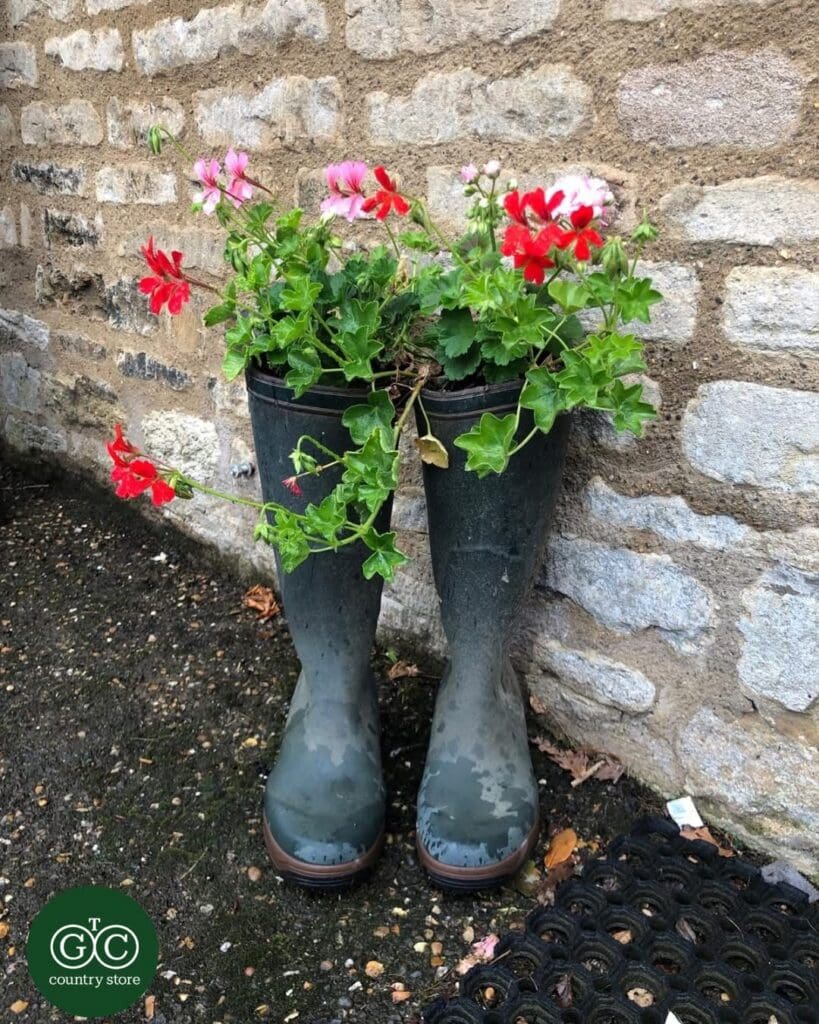
They make cheerful planters. Make a few holes in the soles so the water can drain away, fill them with compost and plant them up. Ours stand outside the shop all year round, planted up for every season, from spring bulbs to bright summer geraniums.
Hang a pair by the back door, with a loop of string through two small holes near the top, and they make a handy home for trowels, pegs or dog leads. A split pair is still perfectly good for pottering about in the garden, too.
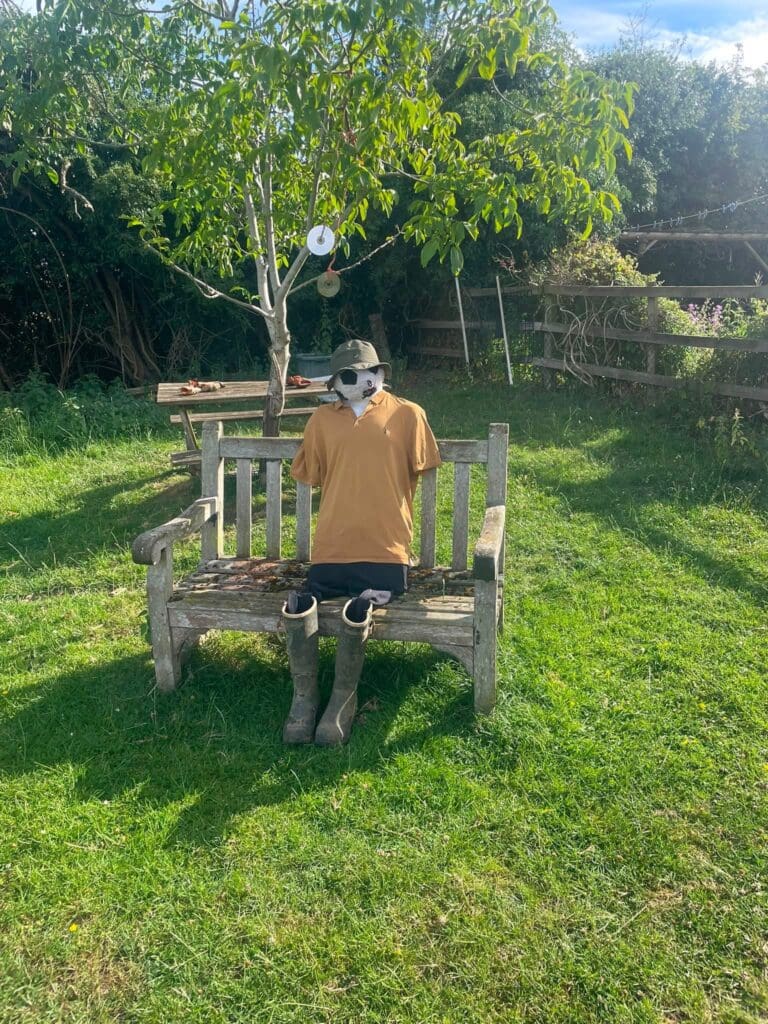
They also finish off a scarecrow nicely. Ours keeps watch from a garden bench in an old pair, hat and all.
And if your old wellies are still sound and simply no longer fit, pass them on to a friend or a local charity, where they will be gratefully worn through a wet winter.
We’d love to know. Are you still wearing the pair you bought twenty years ago, or have you got a pair of Vierzons that have seen more shoots than you can count? Share a photo of your oldest pair with us on Facebook or Instagram. We’d love to see them.
If you enjoyed this, read The Story of the Barbour Jacket, another country classic with a history worth knowing, and find out how to date an old Barbour from the crests on its label.
Promotions, latest products and news directly to your inbox – opt out at anytime.